
A woman points to her chest in the exam room and says she wants a lift, and within the first minute of looking, I can usually tell she needs volume instead, or the reverse. The difference between a breast augmentation and a breast lift comes down to one anatomical question: is the problem missing volume, or is it low nipple position and excess skin?
A breast lift with augmentation, done together, is for the patient who has both. Getting that call right is important in the consultation, and it’s the thing people confuse most.
The markers I look at first include: where the nipple sits relative to the inframammary fold (ideal height is at or above the crease under the breast), relative to the upper arm (ideal height is around the middle of the upper arm), and relative to the breast itself (if there is no visible breast skin below the 6 o’clock position of the areola, no implant alone will fix it).
If the nipple sits too low, that’s called ptosis, and it needs a lift. A hollowed-out upper pole with the nipple still sitting high is a volume problem, and that needs an implant. Same complaint on the surface, different operation underneath.
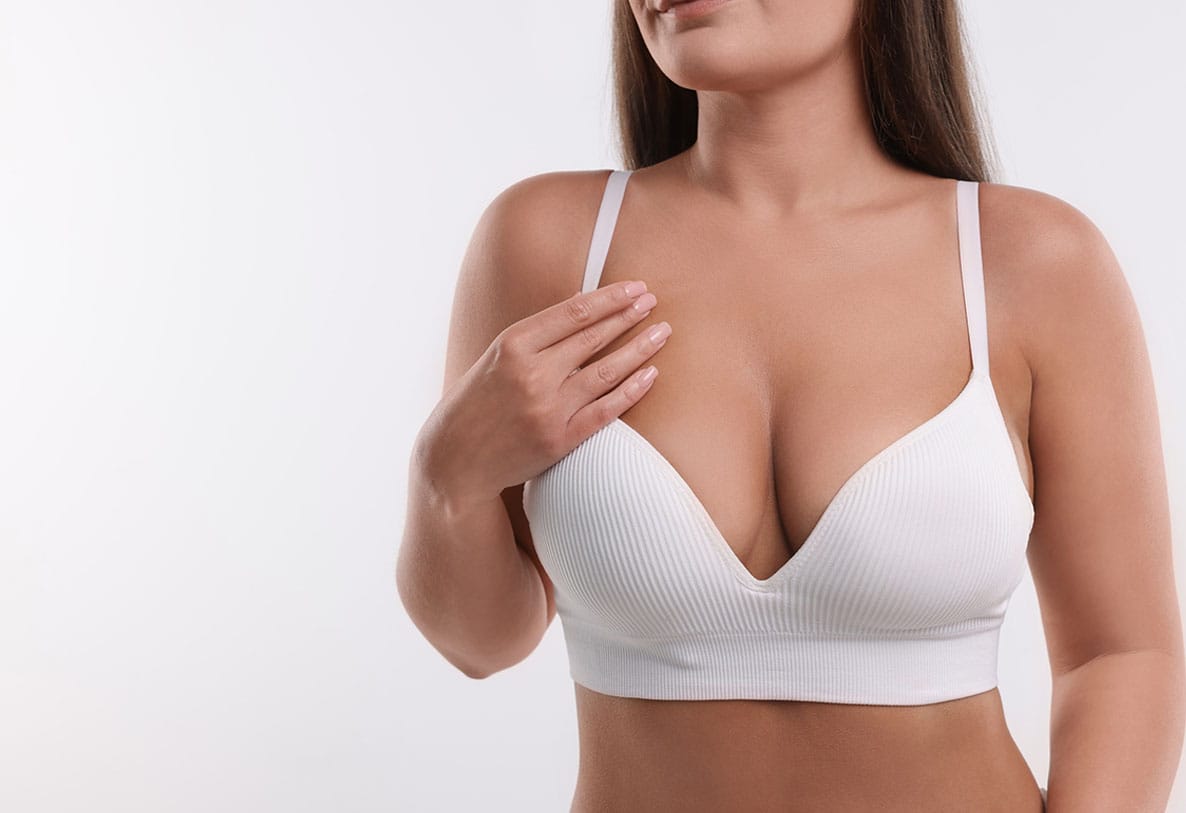
Breast Augmentation vs. Breast Lift: Anatomical Needs
Breast augmentation adds volume and projection with an implant; a breast lift, or mastopexy, tightens the skin envelope and repositions the nipple higher without adding size. Those are two different jobs. An augmentation makes a breast bigger. A lift makes a breast sit where it used to.
The old bedside check still works. If the nipple points down and skin folds under it, laxity is real and a lift is on the table. When someone can hold a pencil in the crease under the breast and it stays put, the skin envelope has stretched past what an implant will correct on its own.
Here’s where people get burned. Putting a large implant into an already-loose envelope does not lift anything. It hangs lower.
Weight history matters in these cases. Someone who lost forty pounds and someone who nursed two children arrive with the same drooping, but the tissue quality isn’t the same, and neither is the plan.
Fatty tissue behaves differently than dense glandular tissue under an implant, and that changes whether I lean toward a lift, an augmentation, or both procedures in one setting.
How Do I Know If I Need a Lift or Implants?
You need a lift when the nipple has descended significantly below the inframammary crease, and you need implants when the breast has lost fullness but the nipple still points forward. That’s the short version, and it holds up in the room more often than not.
The confusion usually starts because deflation after pregnancy feels like sagging. A breast that lost glandular volume looks empty and can read as droopy even when the nipple position is fine.
That patient is frustrated by size, not position, and an implant alone restores the shape she remembers, a dynamic the ASPS breast lift overview describes in clinical terms worth reviewing.
The reverse case is the one that gets over-operated. A patient with good volume and a low nipple needs skin removed, not added. I have watched implants used to chase that problem, and the result is a bigger version of the same droop.
Incision Placement and Surgical Approach
Augmentation incisions in one of three spots, and the choice is driven by anatomy and implant type rather than preference. The inframammary fold incision gives the most direct access and the most predictable pocket control. The periareolar incision sits at the edge of the areola and hides well on some skin tones. The transaxillary incision goes through the armpit and leaves nothing on the breast itself, but it trades away precision.
For thinner patients, coverage is the whole game. When I can pinch less than two centimeters of tissue over the upper pole, I use a dual-plane technique, releasing the lower edge of the pectoralis so the muscle covers the top of the implant and the breast gland drapes the bottom. That combination hides the implant edge that would otherwise ripple through thin skin.
A mastopexy isn’t a skin operation. I reshape the glandular tissue underneath and move the nipple on its blood supply, then tailor the skin to the new mound rather than cinching skin down over an unchanged breast. Skin stretches again. The internal reshaping is what holds.

On implant shape, I lean round for most cases and reserve teardrop implants for patients whose tissue is too thin to disguise a round edge. The choice between silicone vs. saline implants is a separate but related decision that I walk through during consultation.
The Mistake That Changed How I Close
Early in my training I closed lift incisions under too much tension, trusting the skin to do the structural work, and I stopped doing that after watching the results drift. Skin isn’t a load-bearing tissue. When you rely on it to hold a lift, the tension pulls the incision wide, the scar thickens, and within a year the breast bottoms out and the nipple rides up on the mound. The deformity you get from over-tightened skin is harder to revise than the original ptosis.
So now I build the support in the deeper layers, the glandular pillars and the dermis, and I close skin with almost no tension at all. During closure I test it with my hands: if the incision edges want to gap when I let go, I have not put enough of the load into the internal sutures, and I go back in. The number I watch is nipple-to-fold distance on the table, because if that lengthens under tension I know the mound will settle low. That single change, moving the load off the skin, did more for my long-term results than any implant decision.
I will say something that cuts against how these consultations usually go. A fair amount of what walks in for revision was preventable at the first operation, and not by better surgery. By a more conservative first plan.
Breast Surgery by the Numbers
Breast augmentation and breast lift consistently rank among the highest-volume cosmetic procedures tracked by the American Society of Plastic Surgeons (ASPS 2023), and the demand has held steady year over year. The data worth knowing is less about popularity and more about safety and durability.
Certification and facility accreditation are the two variables that move outcomes most. The American Board of Plastic Surgery requires years of accredited surgical training plus written and oral board exams before a surgeon is certified, which is the baseline I would not skip when choosing anyone. Facility matters just as much: our surgery center is AAAASF-accredited with a board-certified anesthesia team on site.
On implants specifically, the FDA has recommended that patients with textured implants be aware of BIA-ALCL, a rare cancer of the immune system associated primarily with certain textured surfaces, based on safety communications the agency has issued over multiple years. Capsular contracture, where scar tissue tightens around the implant, remains a reason for reoperation over a device’s lifespan.
Neither is a reason to avoid surgery. Both are reasons to have the monitoring conversation up front, and the Mayo Clinic’s breast augmentation overview covers these risks in useful patient-facing detail.
Recovery in the First Two Weeks
Patients are typically up and walking the day of surgery and back to a desk job within a week, though the tissue is nowhere near healed at that point. The surgical bra goes on in the operating room and stays on nearly around the clock for the first several weeks, because support during this period is critical.
I restrict overhead reaching and any lifting past a gallon of milk for the early phase. This isn’t caution for its own sake. Straining pulls on the internal repair before it has strength, and with implants it can shift the pocket before scar tissue has stabilized the position.
Light walking starts immediately. I clear most patients for real cardio once the incisions have settled and hold heavier chest-loading work longer, because the pectoralis is involved in a dual-plane augmentation and needs time.
Swelling is the reason results take months to declare. What you see at two weeks isn’t the result.
Frequently Asked Questions
What is the difference between a breast augmentation and a breast lift?
Breast augmentation adds volume to the breast using an implant, while a breast lift (mastopexy) repositions the nipple higher and removes excess skin without changing breast size. The two procedures address different anatomical problems. Augmentation corrects lost fullness when the nipple still sits in a normal position. A lift corrects nipple descent and skin laxity when volume is not the primary issue. Some patients need both procedures performed together.
How do I know if my nipple position means I need a lift instead of implants?
The primary marker is whether the nipple has dropped below the inframammary fold, the crease at the base of the breast. If the nipple sits below that fold and points downward, an implant alone will not raise it and may cause the breast to hang lower. If the nipple still points forward and the fold sits normally, lost volume is the likely problem and an implant is the appropriate correction.
Will a breast implant fix sagging, or do I need a lift?
A breast implant will not correct true sagging if the skin envelope has already stretched beyond the point where added volume provides support. A practical clinical test: if a pencil placed in the crease under the breast stays put without being held, skin laxity is present and a lift is likely necessary. Placing a large implant into a loose envelope does not raise the breast; it adds weight to tissue that is already descending.
Can a breast lift and augmentation be done at the same time?
A breast lift and augmentation can be performed together in a single operation for patients who have both moderate nipple descent and volume loss. Combining the procedures is common and avoids a second surgery and recovery. The decision to combine them depends on tissue quality, degree of ptosis, and implant size, since a very large implant placed into tightened tissue can create competing mechanical forces that affect long-term results. In cases of severe ptosis, I recommend doing a mastopexy first, and re-assessing whether implants are necessary a few months after the mastopexy.
Choosing a Surgeon Is the Safety Decision
The choice of surgeon is the single biggest safety variable in breast surgery, ahead of implant brand, incision type, or anything else on the brochure. Precision of dissection and gentle handling of the breast tissue determine both how you heal and how the result holds up.
Minimal trauma to the breast parenchyma during dissection means less bleeding, less scar formation, and a lower chance of the capsule tightening down the line. That’s a technical outcome, not a marketing claim, and it comes from how the pocket is made, not from the device that goes into it.
Aesthetic goals and long-term breast health aren’t opposites, but when they pull against each other, I side with health. I have declined to place an implant large enough to compromise thin tissue coverage, because a result that looks good at three months and thins out at three years isn’t a result I want my name on. That judgment is part of how I think about revision work, and the process starts at the first operation.
Ready to start your journey? Contact us today to schedule your personalized consultation.

Written by: Dr. Michael Cohen
Board-Certified Plastic Surgeon, Plastic Surgery Center of Hampton Roads
About Dr. Cohen