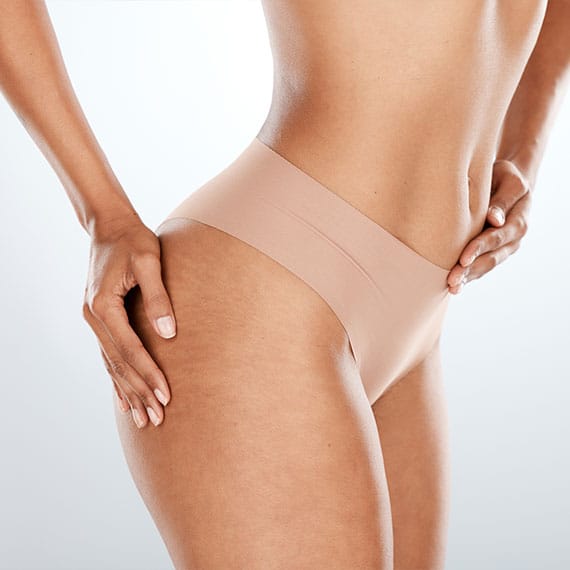
A Brazilian Butt Lift (BBL) is often misunderstood as simply enlarging the butt. Modern BBLs avoid placing fat deep in the gluteal muscle. Intramuscular injection increases the risk because large veins in the muscle can allow fat to enter the bloodstream and reach the lungs, leading to a fat embolism. Muscle placement also makes results less consistent and revisions riskier. In plain language, a BBL is a two-part fat-redistribution procedure. First, we remove your fat from areas where you don’t want it. Then, we layer purified fat under the skin, above the gluteal fascia, to shape the buttocks and hips. This Brazilian Butt Lift guide emphasizes safety: subcutaneous-only placement, real-time ultrasound to verify cannula position, and controlled, low-pressure injection while the cannula is moving.
At PSCHR, we standardize and document each step. The two-part nature is simple.
Part 1: fat is removed using liposuction from donor areas such as the abdomen, flanks, back, or thighs and then purified.
Part 2: refined fat is placed in small, evenly spaced threads in the subcutaneous plane to build projection, add smooth hip sweep, and respect natural anatomy.
A balanced waist-to-hip ratio, attention to symmetry, and modest, well-placed volume usually look more natural and age better than a “more is better” mindset. At PSCHR, we prefer a conversational, open approach because informed patients make better choices. We take the time to understand your unique goals and concerns and tailor our approach to ensure you achieve the results you desire.

The Brazilian Butt Lift Technique: Step-by-Step at PSCHR
Your BBL journey begins with a comprehensive consultation. I listen to your goals, review your medical history, examine tissue and skin quality, and take standardized measurements and photos. My team assesses donor areas, discusses realistic volumes, and tailors pre-op guidance on nutrition, nicotine avoidance, and medication adjustments. If needed, we coordinate medical clearance. On surgery day at our AAAASF-accredited on-site surgical center, you’ll meet our board-certified anesthesiologists. While standing, I mark landmarks and asymmetries, review the plan, confirm consent, and perform a safety time-out. I place sequential compression devices before induction and administer antibiotics per protocol. I infiltrate a tumescent solution to minimize bleeding and improve comfort. Using power-assisted liposuction with 4–5 mm cannulas on gentle settings, I harvest fat from planned donor sites. The fat is processed in a closed, sterile system by decantation and filtration to preserve cell viability and avoid exposure to air or unsterile surfaces. For the transfer, I use large, blunt, single-port cannulas with an inner diameter of at least 3 mm. I inject only while moving the cannula with controlled, low pressure, laying micro-threads of fat to create voluminous buttocks.
At PSCHR, we track volume placed by quadrant. We protect nerves and skin with careful padding and pressure-point management. Why so many steps? Because details matter. Tumescent solution limits bleeding; larger, blunt, single-port cannulas lower the chance of vascular injury; and meticulous threading improves smoothness and graft take. Procedure time typically runs two to four hours, depending on donor sites and contouring complexity. Immediately after surgery, I assess symmetry, apply dressings, and fit a compression garment over the liposuction areas. I position you to avoid pressure on the grafts, coach early mobility, review no-sitting protocols, and connect with your support person. Follow-up visits are scheduled before you go home. I stay attentive from planning to final check because consistency is the foundation of safety.
Who Benefits from Brazilian Butt Lift in My Newport News Practice
Best candidates share several traits: adequate donor fat (typically BMI above about 22), good skin elasticity, a stable weight for at least six months, non-smoking status, realistic goals, and a commitment to aftercare—especially avoiding pressure on grafts early in healing. Patients who value shape as much as size tend to be most satisfied. What’s realistic? About 50–80% of transferred fat typically survives long term, with results stabilizing between three and six months as swelling resolves and grafts settle (Yu et al. 2015; ASPS 2022). Fat is living tissue; it needs a blood supply, gentle handling, and time to integrate.
A brief story illustrates why candidacy matters. A 32-year-old runner from Newport News had a lean frame with minimal donor fat. Rather than attempt a high-risk, high-volume transfer, we staged her plan: first, conservative liposuction with modest hip-dip filling to improve shape; then, after weight stabilization and a few pounds gained, a second small-volume graft. The outcome looked balanced and natural, achieved safely over time rather than in a single, overambitious session.
Not everyone is a candidate. That’s okay. Significant skin laxity may require a lift first; very lean patients might do best with staged grafting or alternatives; active weight loss should pause until stable; and unrealistic expectations require an honest discussion. When it supports proportion safely, we may combine BBL with liposuction, breast procedures, or a thigh & buttock lift—sequenced thoughtfully to protect healing. I’m empathetic but direct because my priority is helping you make an informed, safe choice.
Recovery Timeline: Week-by-Week Expectations
Week 0–1: Expect soreness, swelling, and light drainage from tiny liposuction incisions. Sleep on your stomach or sides. Avoid reclining on your back and direct sitting; if essential, use a BBL pillow briefly with frequent offloading. Wear your compression garment 24/7 over the liposuction areas, except while showering. Begin short walks on the day of surgery to reduce the risk of clots. This is usually the most uncomfortable week, but it gets better each day.
Weeks 2–3: Bruising fades but swelling persists. Many patients return to desk work around 1–2 weeks if they can stand, alternate positions, or use a BBL pillow with breaks. Continue sitting modifications. If cleared, you may start lymphatic drainage with a trained therapist. Prioritize hydration and adequate protein to support healing and energy.
Weeks 4–6: Gradually expand activity. Light, low-impact cardio often resumes in this window. Sitting progresses to brief intervals with a BBL pillow if we’ve discussed it during your visit. Depending on your exam, we may transition to daytime-only compression around weeks 4–6. You’ll start to see early shape changes, but swelling still obscures fine details—patience is key.
Weeks 6–8: With surgeon approval, most patients resume normal sitting between weeks 6–8. Daily activities normalize. Lower-body training restarts gradually after clearance—mobility first, then progressive load and intensity. Swelling continues to taper.
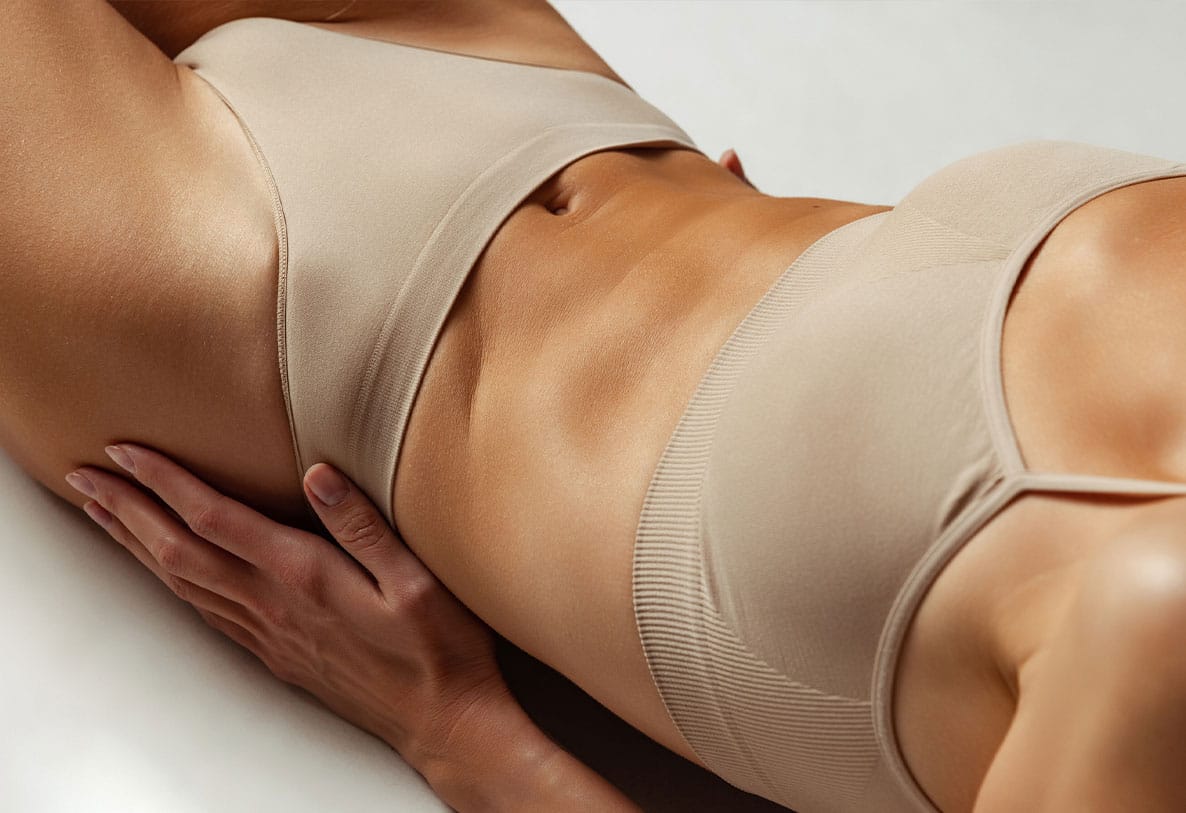
Months 3–6: Fat survival stabilizes between three and six months, and final shape is typically evident by six months (ASPS 2022; Aesthetic Surgery Journal 2015). Maintain a stable weight to protect your result; significant loss or gain can change outcomes.
Follow-up schedule: I will see you at approximately one week, six weeks, three months, and six months at our Newport News or Williamsburg office. At each visit, we adjust garment wear, activity progression, and sitting rules based on your healing. Realistic challenges include stomach-sleeping frustration, tightness in liposuction areas, and early energy dips. Walk daily, hydrate, prioritize protein, and call if you’re worried. Warning signs that require immediate contact include fever, increasing or disproportionate pain, shortness of breath, calf tenderness, chest pain, or one-sided leg swelling.
Safety, Risks, and When I Say No
The most serious complication we discuss is fat embolism, where fat enters the bloodstream and travels to the lungs. Historically, estimates were about 1 in 2,500–3,000 procedures (ASERF Gluteal Fat Grafting Task Force 2018). With subcutaneous-only techniques and routine ultrasound guidance, contemporary estimates appear much lower—roughly 1 in 15,000–20,000 (ASERF/WAGS 2023; Modern Aesthetics 2023). As this Brazilian Butt Lift guide underscores, numbers matter, but technique matters more. Other material risks include infection, seroma (fluid accumulation), contour irregularities or asymmetry, temporary numbness or altered sensation, small scars at incision sites, under- or over-correction, need for revision, and blood clots. We mitigate risk with antibiotics, sterile technique, closed-system processing, meticulous hemostasis, and early ambulation with compression. Safety Pillars at PSCHR (our non-negotiables):
- Subcutaneous-only grafting with real-time documentation
- Large, blunt, single-port cannulas (≥3 mm)
- No intramuscular injection or downward angulation
- Quadrant-by-quadrant volume tracking tailored to tissue compliance
- AAAASF-accredited OR with board-certified anesthesiologists
- Tumescent infiltration and meticulous hemostasis
- DVT prevention: risk stratification, SCDs before induction, early ambulation
- Two-person verification of cannula depth and plane
- Strict nicotine abstinence pre- and post-op, with testing as indicated
- Closed-system fat processing and sterile handling
- Pressure-point protection and careful positioning
- Structured follow-up with sitting and activity milestones
When do I say no? Active nicotine use is a hard stop—nicotine compromises blood flow and jeopardizes fat graft survival. Certain clotting disorders are absolute contraindications. Severe skin laxity may require a lift before any volume addition. And when anatomy and expectations don’t align with safe outcomes, I recommend alternatives or staging. My ethics are simple: my job is to tell you what’s safe and achievable, not just what you want to hear. Could I do more volume? Sometimes. Should I? Only when your tissues and safety allow it.
Making Your Decision: Next Steps at PSCHR
When you compare options, focus on the essentials: an ABPS board-certified plastic surgeon, an accredited surgical facility, a subcutaneous-only technique, transparent safety protocols, and expectations that align with your anatomy. At PSCHR, you’ll work with an ABPS board-certified, fellowship-trained cosmetic surgeon; a team with 90+ years of combined experience; and a culture of transparency about risks and when we say no. Use this Brazilian Butt Lift guide to evaluate any practice you consider. It matters because consistency and safety drive results. During your visit, we’ll review your anatomy, set realistic expectations, explain our protocols, and create a personalized plan that aligns with your goals and biology. Schedule a consultation at our Newport News or Williamsburg office to discuss your goals. At PSCHR, we’re committed to natural results achieved safely—every step of the way. For additional wellness services, explore our Med Spa offerings.

Written by: Dr. Michael Cohen
Board-Certified Plastic Surgeon, Plastic Surgery Center of Hampton Roads
About Dr. Cohen